|
|
|
| HomeClocks WatchesAutomataMusical and Scientific InstrumentsServicesInteresting Projects About Contact | ||
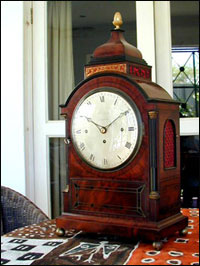
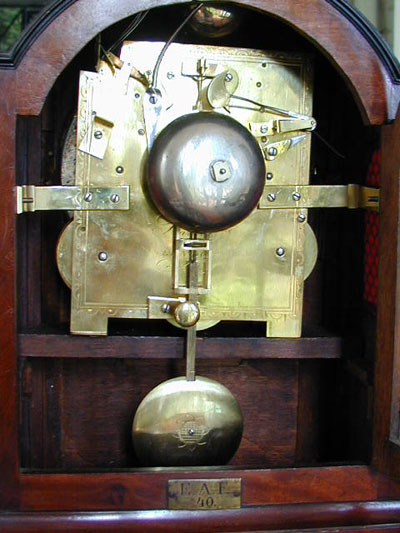
A1449 - Handley & Moore
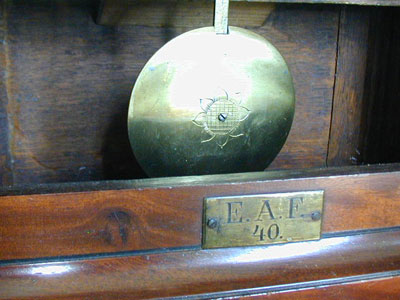
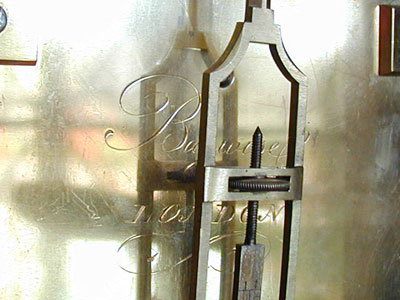
This clock was housed in the Falconberg castle, one of 3 castles owned by the Kings of Hannover until it was auctioned off with the contents of two of the castles. Castle Marienburg remains intact and hosted the auction in 2005. George Handley, who was apprenticed to John Thwaites, traded at 38/39 Clerkenwell Close. The company was started in 1800. His partner, John Moore, was also apprenticed in the same place under John Thwaites. The company did not seem to build many clocks themselves, but produced movements for other makers to use. In a trade directory for London 1822/3 they are listed at 39 Clerkenwell Close.
The firm became John Moore and Sons after Handley died in 1824. In 1949 Benjamin R. & J. Moore published a pattern book called "Designs for Clocks". John Moore exhibited at Great Exhibitions of 1851 and 1862, winning a medal at the latter. The firm appears in an 1856 trade directory at 38 & 39 Clerkenwell Close as clock makers, also church clock makers and musical clock makers. In the London Wholesale, Manufacturing and Retail Goldsmiths, Silversmiths, Jewellers, Watchmakers, Opticians and Cutlers Directory 1861 they are listed the same address, as clock manufacturers to the public and the trade. They also list the musical clock church clock business. By 1877 the firm is recorded as having made over 15,000 house clocks. In a later directory, 1895, they are still listed at 38 & 39 Clerkenwell Close, E.C. but had added "makers to Her Majesty the Queen, the Empress Eugenie & various Government departments: by appointment to the Fisheries, Health, Colonial & Indian Exhibitions." They disappear from trade directories soon after and the last of the clock making Moore's, Henry James died in 1899 aged 60. The business is said to have carried on into the 20th century The business of Handley & Moore took on apprentices:- George Shave, apprentice clockmaker, St. James, Clerkenwell, Middlesex on 11 Aug. 1801 for 7 years from the previous November and the fee of £20. Britten records an example of their work in the British Museum.
Click here to enquire about this item
|
||